Volumes
- Foreword to English Edition
- Published Volumes
- Forthcoming Volumes
“When the decision was made to edit and publish Jacques Derrida’s teaching lectures, there was little question that they would and should be translated into English. From early in his career, in 1968, and annually thereafter until 2003, Derrida regularly taught at U.S. universities. It was his custom to repeat for his American audience the lectures delivered to his students in France the same year. Teaching first at Johns Hopkins and then at Yale, he read the lectures in French as they had been written. But from 1987, when he began teaching at the University of California, Irvine, Derrida undertook to lecture in English, improvising on the spot translations of his lectures. Recognizing that the greater part of his audience outside of France depended on translation was easier, however, than providing an ad libitum English version of his own elegant, complex, and idiomatic writing. In the circumstance, to his evident joy in teaching was often added a measure of suffering and regret for all that remained behind in the French original. It is to the memory of Derrida the teacher as well as to all his students past and still to come that we offer these English translations of “The Seminars of Jacques Derrida.”
The volumes in this Series are translations of the original French editions published by Éditions Galilée, Paris, and will in each case follow shortly the publication of the corresponding French volume. The scope of the project, and the basic editorial principles followed in establishing the text, are outlined in the General Introduction to the French Edition, translated here. Editorial issues and decisions relating more specifically to this volume are addressed in an Editorial Note. Editors’ footnotes and other editorial interventions are all translated without modification, except in the case of footnoted citations of quoted material, which refer to extant English translations of the source as necessary. Additional translators’ notes have been kept to a minimum. To facilitate scholarly reference, the page numbers of the French edition are printed in the margin on the line at which the new page begins.
Translating Derrida is a notoriously difficult enterprise, and while the translator of each volume assumes full responsibility for the integrity of the translation, as Series editors we have also reviewed the translations and sought to ensure a standard of accuracy and consistency across the volumes. Toward this end, in the first phase of work on the Series, we have called upon the advice of other experienced translators of Derrida’s work into English and wish to thank them here: Pascale-Anne Brault, Michael Naas, Elizabeth Rottenberg, and David Wills.”
Geoffrey Bennington
Peggy Kamuf
January 2009
The Beast and the Sovereign, Volume I.
(Chicago: University of Chicago Press, 2009),
© 2009 by The University of Chicago. All rights reserved.
1. Séminaire: La Béte et le souverain volume I (2001-2002), edited by Michel Lisse, Marie-Louise Mallet, and Ginette Michaud, Paris: éditions Galilée, 2008; 463 pp. More
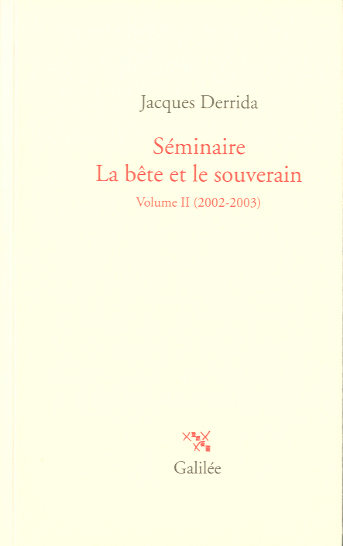
2. Séminaire: La Béte et le souverain, volume II (2002-2003), edited by Michel Lisse, Marie-Louise Mallet, and Ginette Michaud, Paris: éditions Galilée: 2010 More
3. Séminaire: La Peine de mort volume I (1999-2000), edited by Geoffrey Bennington, Marc Crépon, and Thomas Dutoit, Paris: éditions Galilée, 2012; 386 pp. More
4. Heidegger: la question de l'Être et l'Histoire (Cours de l"ENS-Ulm 1964-1965), edited by Thomas Dutoit with Marguerite Derrida, Paris: éditions Galilée, 2012; 326 pp. More
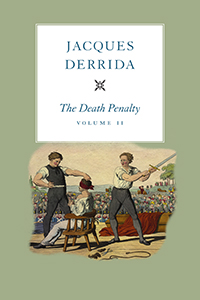
5. La peine de mort volume II (2000-2001), edited by Geoffrey Bennington and Marc Crépon, Paris: éditions Galilée, 2012; 376 pp. More
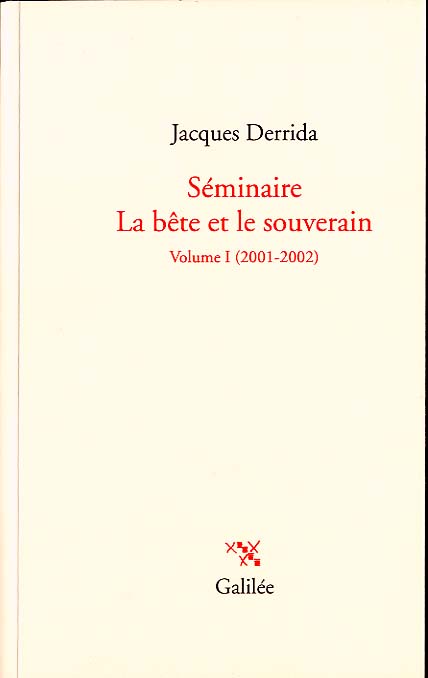
1a. The Beast and the Sovereign, Volume I, translated by Geoffrey Bennington, Chicago: University of Chicago Press, 2009; xvi + 349 pp. More
2a. The Beast and the Sovereign, Volume II, translated by Geoffrey Bennington, Chicago: University of Chicago Press, 2011; xix + 293 pp. More
3a. The Death Penalty, Volume I, translated by Peggy Kamuf, Chicago: University of Chicago Press, 2013; xviii + 312 pp. More
4a. Heidegger: The Question of Being and History, translated by Geoffrey Bennington, Chicago: University of Chicago Press, 2017; xxii + 264 pp. More
5a. The Death Penalty, Volume II, translated by Elizabeth Rottenberg, Chicago: University of Chicago Press, 2017; xviii + 304 pp. More





All publication dates for the following volumes are projected.
Theory and Practice (1976-77), translated by David Wills, Chicago: University of Chicago Press, 2018
La vie la mort (1975-76), Paris: Éditions du Seuil, 2019
Séminaire: Le Parjure et le pardon, volume I (1997-1998), Paris: Éditions du Seuil, 2019
Life Death, translated by Michael Naas and Pascale-Anne Brault, Chicago: University of Chicago Press, 2020
Perjury and Pardon, Volume I, translated by David Wills, Chicago: University of Chicago Press, 2021
Séminaire: Le Parjure et le pardon, volume II (1998-1999), Paris: Éditions du Seuil, 2020
Perjury and Pardon, Volume II, translated by David Wills, Chicago: University of Chicago Press, 2022